
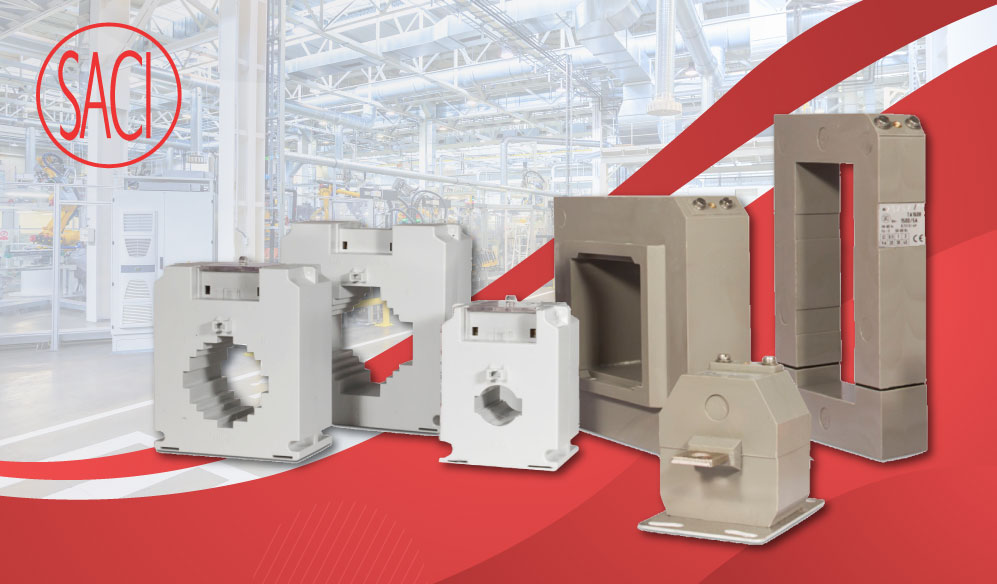
In this blog we will focus on the characteristics of low voltage instrument transformers, in which we are specialists.
The core is the most important part of a transformer, The material from which it is made also has a great influence on its performance and characteristics. In addition, the material it is made of will also have a major influence on its performance and characteristics. efficiency and applications. Here are the most commonly used materials for this part of the transformer.
Iron core
Iron has strong magnetic properties and, therefore, the efficiency of the transformer will be very high. The most commonly used are those made of laminated silicon iron and, in general, all of them are relatively inexpensive. However, in contrast, they are very robust and have a high durability.
Ferrite core
It has a high magnetic permeability, offering very low losses when there is a high frequency, so they are used especially when a very high accuracy is required. This is why they are often used in radio frequency or switching power supplies, and much more in electronic applications (television, computers, telephones...) than in electrical applications, as well as in the industrial and automotive sector.
Compared to iron core transformers, ferrite transformers are more efficient than iron core transformers. compact and lightweight, They are therefore more suitable when the available size is smaller. However, they are more expensive and more fragile than iron ones.
Air core
In this case no solid magnetic material is used, but the transformer flux connection is made using air. They have a very good wide frequency range, a high level of adaptability to the available space and low losses.
They are widely used for radio frequency equipment and in research laboratories where measuring and testing equipment is present. However, it can be somewhat less efficient and more susceptible to electromagnetic interference from other fields.
At SACI we work with iron cores for the primary voltage or current, while the secondary current output is through a copper winding.
What you need to know to choose the most suitable electrical transformer
-
- Know which magnitude you want to measure: current or voltage.
- What function is performed: measurement, protection, addition.
- Type of transformer: Closed, open or wound.
- Transformer location and environmental conditions: resin, plastic or resin-filled plastic transformer material.
- Accuracy class, power, primary intensity and secondary intensity.
- External dimensions of the transformer, window dimensions
Cable cross-section
|
Nominal cross-section (mm2) |
Cable outside diameter (mm) |
|
1×1,5 |
6,2 |
|
1×2,5 |
6,6 |
|
1×4 |
7,6 |
|
1×6 |
8,3 |
|
1×10 |
8,9 |
|
1×16 |
10,5 |
|
1×25 |
12,2 |
|
1×35 |
13,5 |
|
1×50 |
15,7 |
|
1×70 |
18,2 |
|
1×95 |
20,8 |
|
1×120 |
22,7 |
|
1×150 |
25,4 |
|
1×185 |
28 |
|
1×240 |
31,6 |
|
1×300 |
34,7 |
|
1×400 |
36,2 |
|
1×500 |
40,2 |
|
Nominal cross-section (mm2) |
Cable outside diameter (mm) |
|
2×1,5 |
10,2 |
|
2×2,5 |
11,2 |
|
2×4 |
13 |
|
2×6 |
14,6 |
|
2×10 |
16,8 |
|
2×16 |
19,9 |
|
2×25 |
23,3 |
Now that you know what types of transformers are available depending on the core material, our team of experts can help you find the right one. Contact with us by filling in our form, calling us by phone or sending us an email. We will be happy to help you and find the best solution for your company.