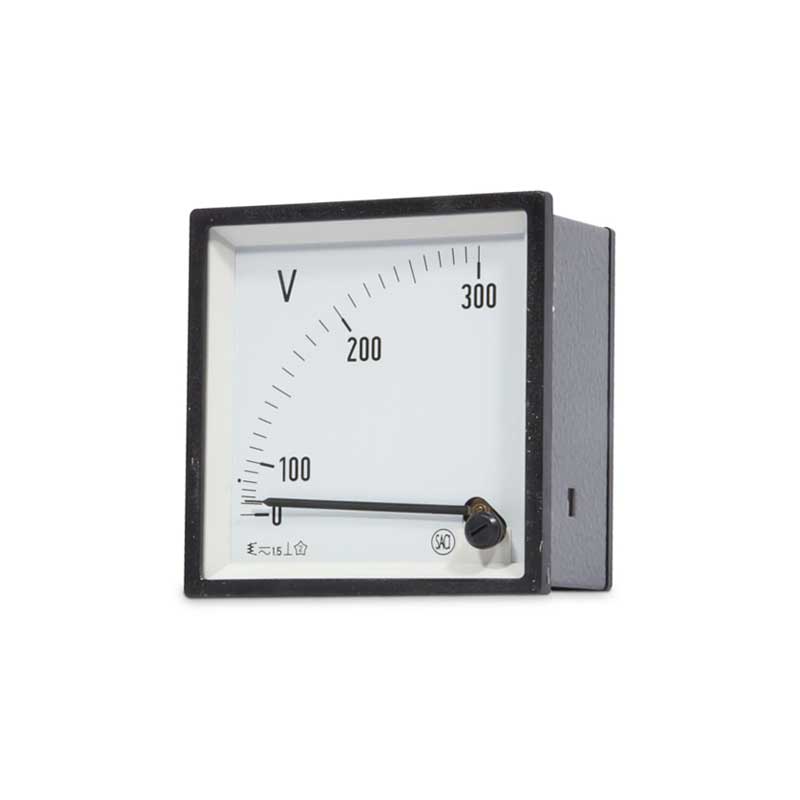
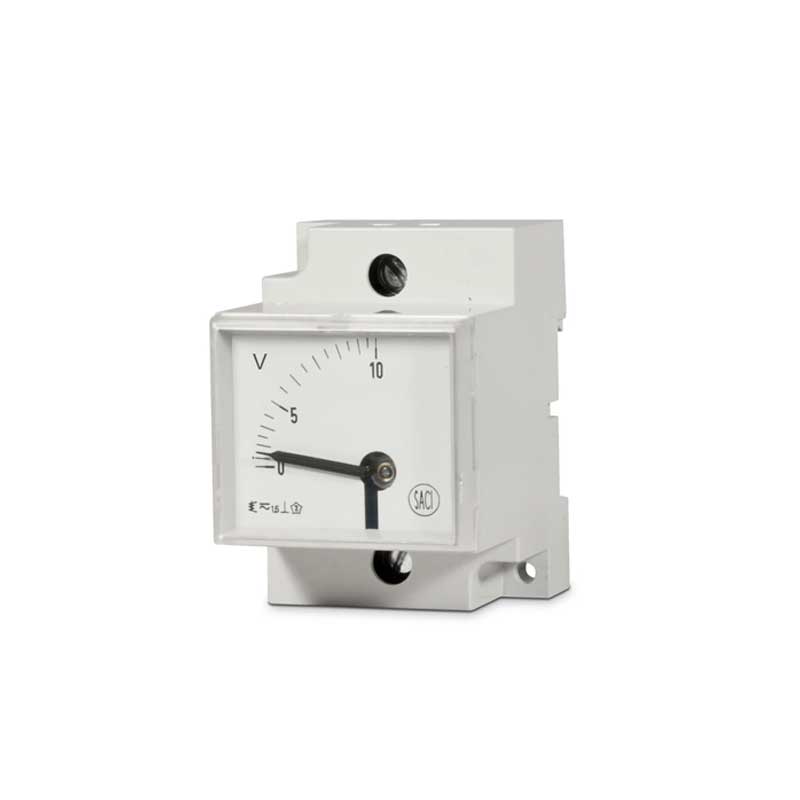
Voltmeters - Interchangeable scale
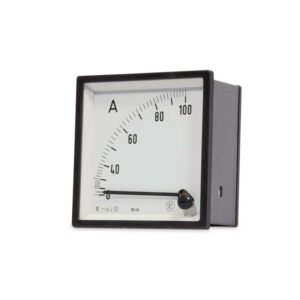
Moving iron voltmeter, with voltage measurement. True RMS value. Interchangeable scale option. DIN rail or panel
Moving iron voltmeter, with voltage measurement. True RMS value. Interchangeable scale option. DIN rail or panel
Technical details
- Description
- Technical characteristics
- Technical data
Our mobile iron voltmeter
A voltmeter is a analogue instrument or digital which serves to measuring the potential difference between two points in the same electrical circuit. Virtually all voltmeters can perform these measurements on most electrical devices. They are also capable of measuring DC currents, transistors and even battery testing. We have a wide range of voltmeters available on our website, including a moving iron voltmeter with voltage measurement and an interchangeable scale option.
How is this instrument used?
For the measurement of the potential difference to be correct, the following must be done place it in parallel. That is to say, in shunt on the points between which the measurement is to be made. This means that the instrument must have as high an internal resistance as possible so that the voltage is not measured incorrectly.
The voltmeter records the positive electrical charge flowing through one point of the electrical circuit. It then measures the negative charge at another point. It is therefore not surprising that these devices are found in everyday objects, such as a car. The car voltmeter measures the voltage between two battery terminals to check the proper functioning of your electrical system.
The different types of voltmeters
Generally speaking, there are two types: analogue and digital. Analogue instruments are ideal for measuring voltage, resistance, current, signal power and frequency. This type of instrument is characterised by a higher accuracy than the digital ones in terms of diode testing. On the other hand, the digital voltmeters are known for their accuracy in calculations such as resistance, voltage and current. It should be added that the accuracy is tighter than analogue, as they display numbers to exact decimal places. They can also be set to measure in ohms, amps and volts.
Parts of a voltmeter
All these instruments are characterised by having:
-
- A positive input terminal, which is normally red.
- A negative input terminal, which is normally black.
- If it is analogue, it shall have a scale on which the measurement results can be read. If it is digital, the results can be read on the LED or LCD display.
Voltmeter, voltmeter or ammeter?
Although all three are measuring instruments, it is important to differentiate between them. First of all, it is important to consider that a voltmeter measures the voltage, i.e. the electrical potential, while a voltmeter measures the electrical charge. In addition, the former expresses the measurement in volts and the latter in coulombs.
On the other hand, the difference between a voltmeter and a ammeter is that the former measures the voltage of the electrical circuit and the latter the current intensity. A decisive aspect in differentiating between them is that the voltmeter is connected in parallel and the ammeter is connected in series.
DIN rail
EC5VR - 45×52,5 mm DIN - 0,15kg
Scale 90º Lateral
EC5V - 48x48mm - 0,14kg
EC4V - 72x72mm - 0,2kg
EC3V - 96x96mm - 0,25kg
Measuring range: 100V, 110V
Scale: 90º.
Frequency: 45...65 Hz
Accuracy: 1,5 %
Own consumption: 1.5...3 VA
Module: 1.2 x/100 V or 1.2 x/110 V
Scale (Vn): 1,2 times the primary of the Voltage Transformer