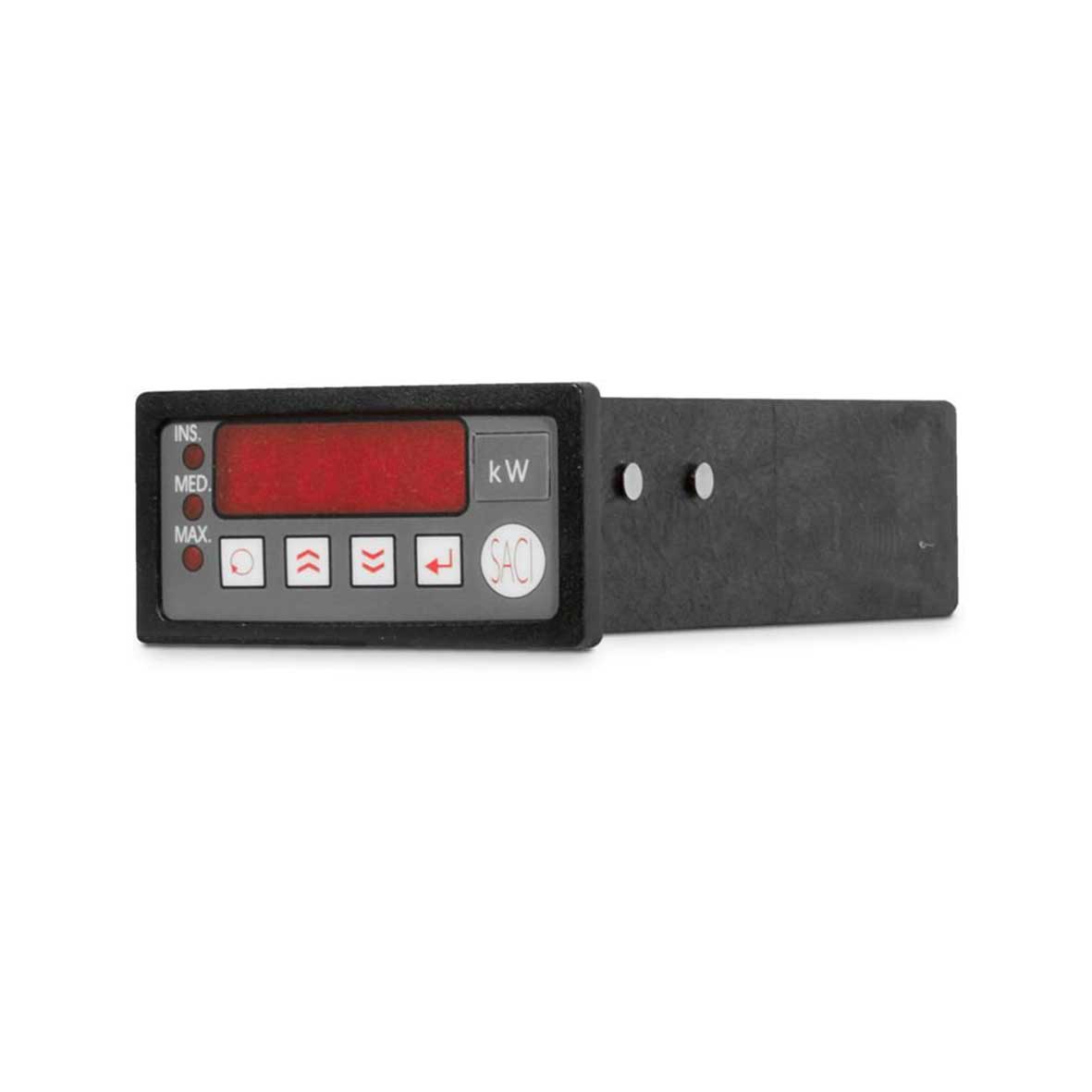
Digital programmable wattmeters
Digital wattmeters are measuring instruments that display the electrical power of a circuit. In other words, it indicates the amount of energy that has been consumed or generated in a certain period of time, usually per second (Ws).
Digital wattmeters are measuring instruments that display the electrical power of a circuit. In other words, it indicates the amount of energy that has been consumed or generated in a certain period of time, usually per second (Ws).
Technical details
- Description
- Technical characteristics
- Technical data
What do you mean they are programmable?
These SACI digital wattmeters are programmable, which means that you can configure and customise some of its features according to your needs. For example, you can set an alarm to be activated when a certain power threshold is exceeded or when an error is detected.
Another customisable option is to programme the ratio of the current and voltage transformers according to the needs of the installation.
Features of SACI digital programmable wattmeters
SACI digital wattmeters can display up to four digits on the display, offering high brightness for better visualisation. Thanks to this wide numerical range, our digital wattmeters have a high greater precision.
In addition, we have models suitable for single-phase electrical circuits with single-phase AC power, which is more commonly used in households, and models for three-phase circuits with three phases of alternating current, more suitable for industrial or commercial sectors where a higher amount of power is required.
All our products comply with current regulations and are accompanied by instructions for their correct use and installation.
Uses of wattmeters
Wattmeters can be used in different environments and for different purposes. Here are the most common ones:
- Residential environment: Although it is not a very common practice, there are people who use digital wattmeters at home to know the exact consumption of their electrical appliances. In this way, they can make better decisions about their usage and reduce their electricity bills. However, in these cases, it is not digital wattmeters like this one that are used, but those that can be plugged into a socket. However, devices such as this one that we sell can be seen in neighbourhood communities.
- Industrial sector: This is one of the sectors for which SACI's digital wattmeters are designed. They help to know the energy efficiency of the equipment and to know if any of it is consuming more energy than expected, which could be a sign of failure or deterioration. In that sense, they are also interesting to prevent damage and prevent equipment from being completely ruined by acting too late.
- Renewable energy sector: Especially in solar and wind installations, digital wattmeters like the ones we sell at SACI are used to measure the energy generated and to know if the systems are performing well.
Wattmeters, energy meters and voltmeters - what's the difference?
These three instruments, although they are energy measurement devices, The different aspects of the electrical circuit are analysed.
Digital wattmeters such as the one on this page measure electrical power, i.e. the rate at which energy is consumed or produced over a period of time. In contrast, digital energy meters indicate the amount of energy that has been consumed in a specific period of time. Finally, the voltmeters measure the electrical voltage between two points in the circuit.
Wattmeters are most interesting for to detect possible anomalies in electrical equipment and to assess the performance of equipment. Meters, on the other hand, are more useful for keeping track of electricity consumption, while voltmeters are more useful for checking the voltage of a power supply.
If you have any questions about our products, please do not hesitate to contact us at web form, via email or telephone.
DP35W (96×48) - Single phase. Alternating current
DP35WI (96×48) - Three phase. Balanced AC current
- Keypad-programmable current and voltage transformer ratios.
- Alarm (optional) programmable by keypad.
-Display: LED, red, digit height 14.3 mm, high luminosity
-Max. reading: From -1999 to 9999
-Overrange indication: OFL
-Voltage input: 110, 230 or 400 V AC.
Self-consumption: < 1 mA per phase (measured) // < 3 VA between phases (balanced three-phase) or between phase and neutral (single-phase)
-Current input: 1 or 5 A AC / Self consumption< 0.25 VA
-Accuracy: 0.5% of Full Scale Value ± 1 Digit
-Temperature coeficient: 0.01%/°C
Alarm circuit: Optional programmable alarm, max. or min. value 1 potential-free contact (250 V, 3 A, 200 VA)