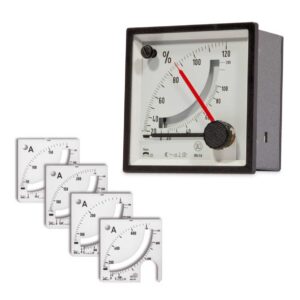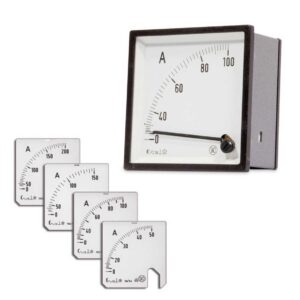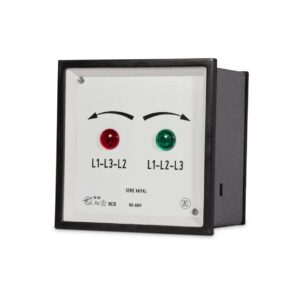
Ammeters - Interchangeable scale
Moving iron ammeter with AC current measurement. True RMS value. Fixed or interchangeable scale options. Panel mounting.
Moving iron ammeter with AC current measurement. True RMS value. Fixed or interchangeable scale options. Panel mounting.
Technical details
- Description
- Technical characteristics
- Technical data
Our mobile iron ammeter
An ammeter is a galvanometer with a parallel resistor, which is called a shunt resistor. Typically, the ammeter is used for measuring the intensity of electric currents. If you have a range of shunt resistors, you can have an ammeter with more than one range or measuring range. In addition, this instrument has a fairly small internal resistance in order not to make the current to be measured smaller when connected to an electrical circuit. At SACI we have moving iron ammeters with AC current measurement and with fixed or interchangeable scale options.
How to use an ammeter
To measure, it is important that the current passes through the ammeter. In this way, serial installation is necessary so that the current can flow.
The instrument must have a very small internal resistance This is so that a voltage drop can be avoided, since being so small helps more electrons to pass through and the measurement to be correct. If the current is to be measured without opening the circuit, it is necessary to use a clamp ammeter, which measures the current indirectly through a magnetic field that produces the current.
Types of ammeters
There are different types of ammeters which, in general terms, are analogue ammeters, digital ammeters and clamp ammeters. The former are analogue instruments These are quite old and, despite the advance of technology, are still very useful today. They provide a measurement result by means of a pointer between the minimum and maximum on the display panel.
Secondly, the digital ammeters are those that use a shunt resistor and an analogue-to-digital converter. Instead of a panel with a needle, they have a display on which the digits can be seen. Finally, it is worth mentioning that clamp ammeters are also a very useful type of ammeter, since they allow a temporary and instantaneous measurement of the current without interrupting or opening the circuit.
Connect your ammeter in series
This instrument is connected in series in the circuit, so it inevitably passes through the current of the circuit. It therefore measures the current passing through it, which is exactly the same as the current in the circuit.
Portable ammeters or clamp ammeters have clamps that are made to be inserted into the wire of the circuit through which the current or intensity to be measured is flowing. It is important to note that they are only placed on one wire, not both at the same time.
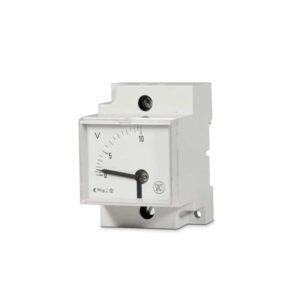
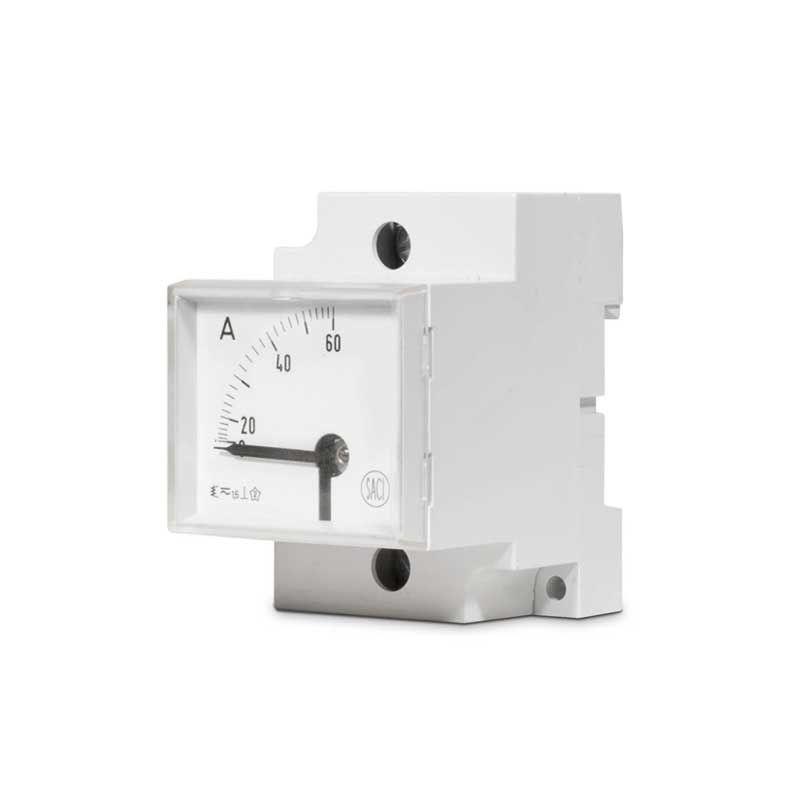
DIN rail
EC5VR - 45×52,5 mm DIN - 0,15kg
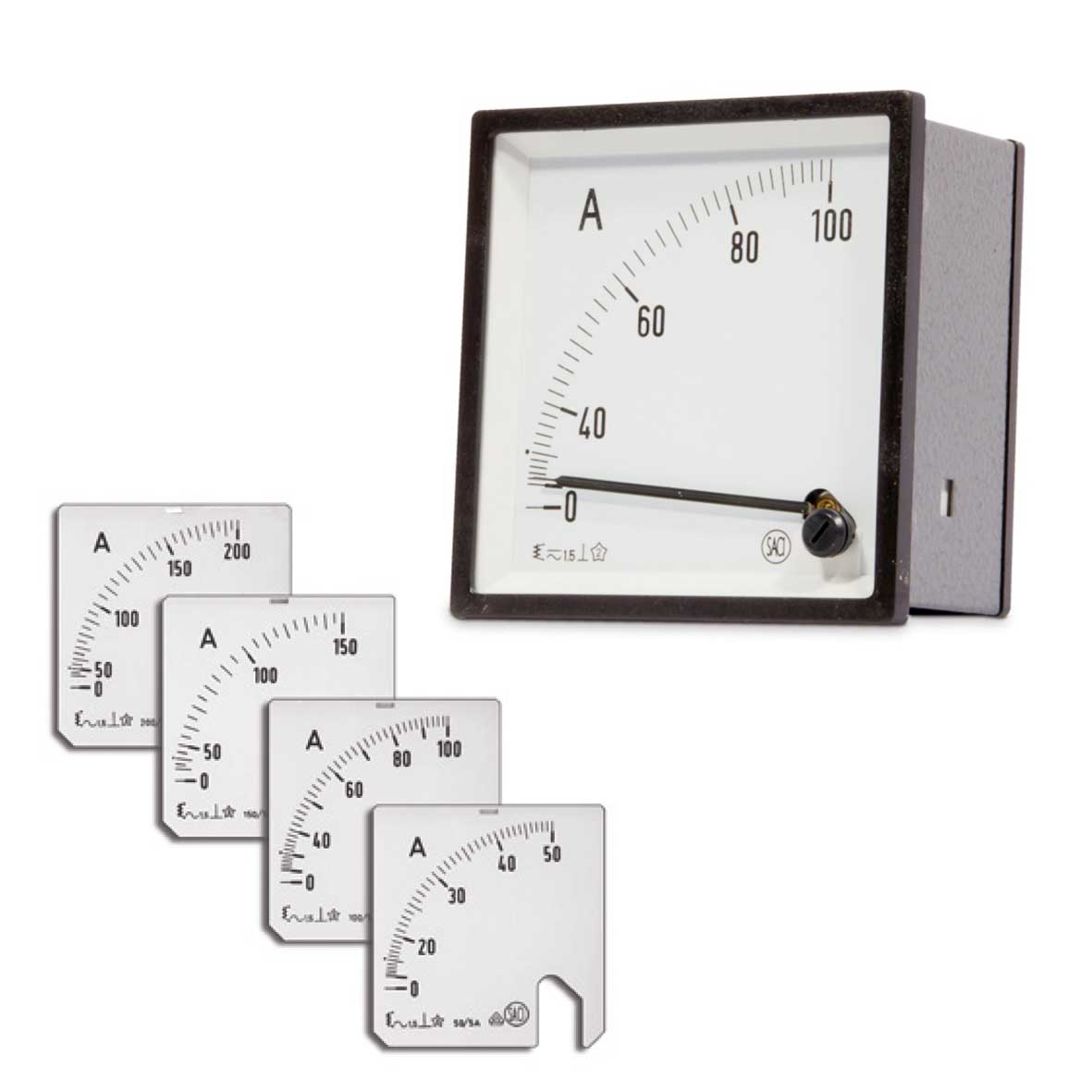
Interchangeable scale 90º Lateral
EC5V - 48x48mm - 0,14kg
EC4V - 72x72mm - 0,2kg
EC3V - 96x96mm - 0,25kg
EC2V - 144x144mm - 0,5kg
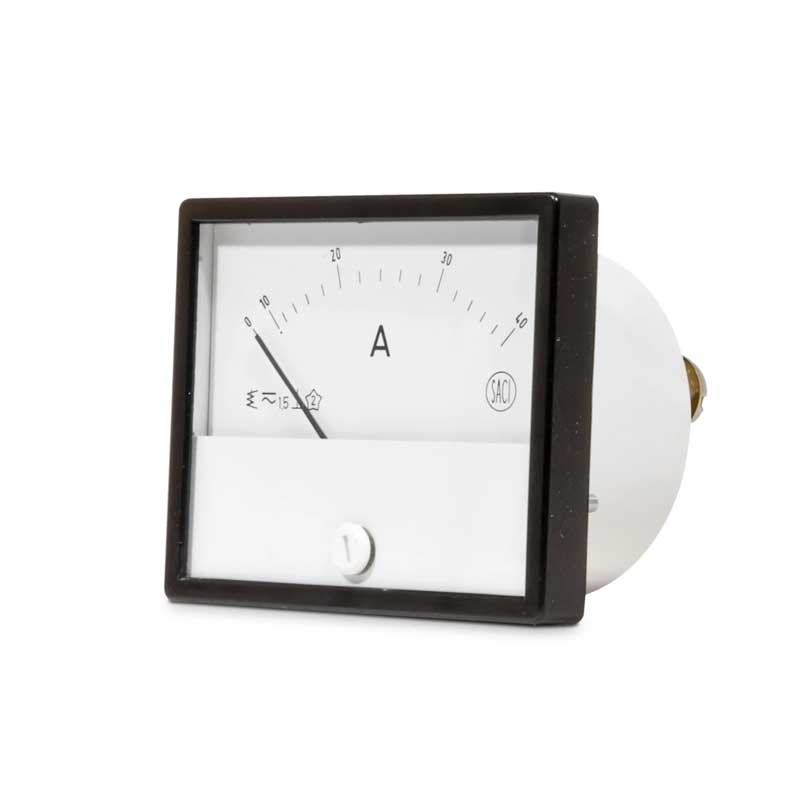
Fixed scale 90º central
Ecb7 - 80x64mm - 0,14kg
Ecb3 - 105x80mm - 0,18kg
Ecb8 - 130x100mm - 0,25kg
- Measuring range: x/1 A, x/5 A
- Scale: 90º.
- Accuracy: 1,5 %
- Frequency: 15...100 Hz
- Own consumption: 0.4 VA
- Module: X/5A or X/1A. Standard scales (ln): 10; 15; 20; 25; 30; 40; 50; 60 or 75 A and multiples thereof.
- Module: 2X/5A or 2X/1A. Standard scales (2xln): 10..20; 15..30; 20..40; 25..50; 30..60; 40..80; 50..100; 60..120 or 75..150 A and multiples thereof.
- Module: 5X/5A or 5X/1A. Standard scales (5xln): 10..50; 15..75; 20..100; 25..125; 30..150; 40..200; 50..250; 60..300 or 75..375A and multiples.