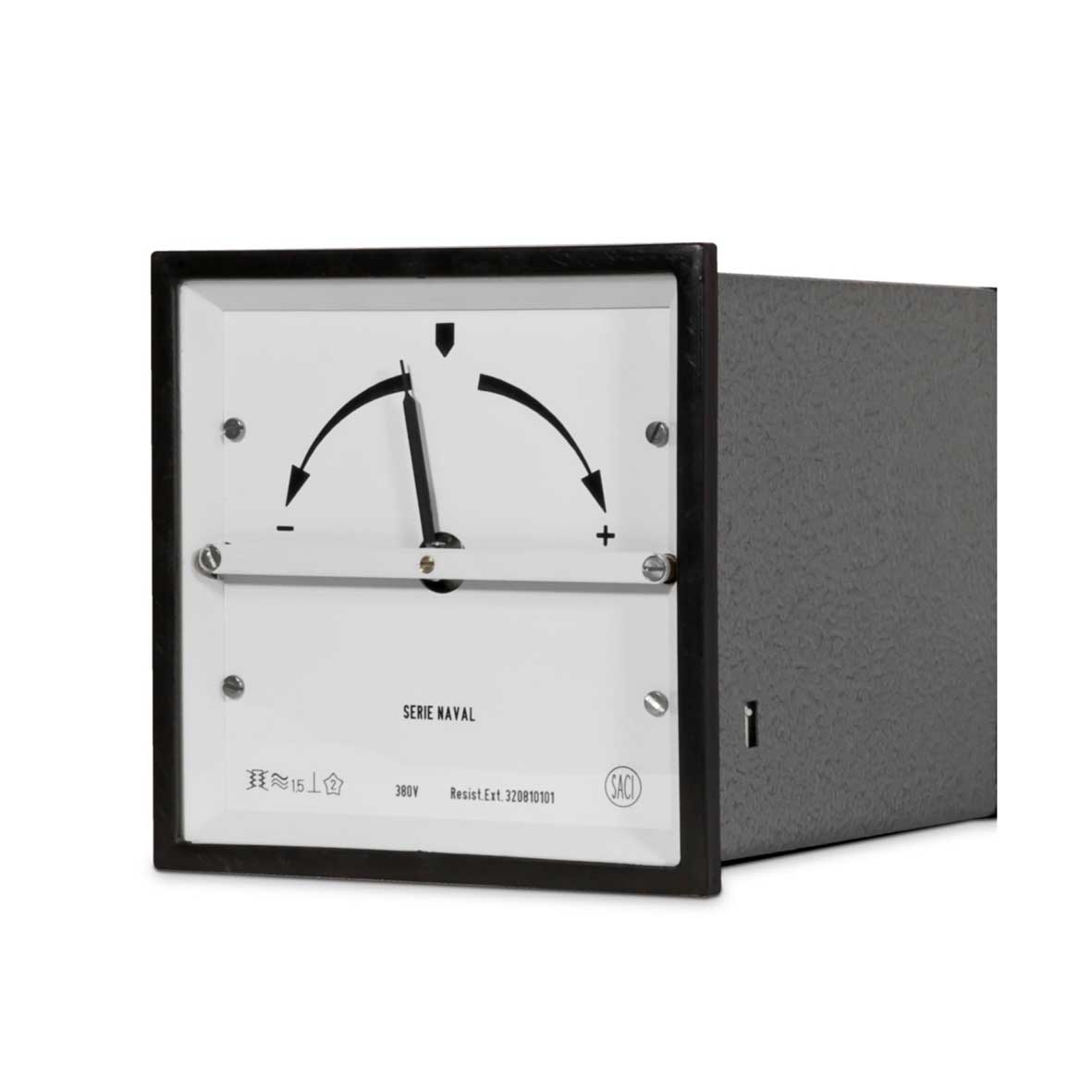
Synchroscopes
A synchroscope is a measuring instrument used in electrical systems to compare and adjust the phase and frequency between two alternating current signals.
A synchroscope is a measuring instrument used in electrical systems to compare and adjust the phase and frequency between two alternating current signals.
Technical details
- Description
- Technical characteristics
- Technical data
Its main function is to facilitate the synchronisation of electrical generators or other power sources with the grid by ensuring that both signals are in phase and have the same frequency before connecting them. This is crucial to avoid damage to equipment or interruptions in the electrical system. The device visually displays the phase difference (usually by means of a needle or display) and allows the operator to make the necessary adjustments to achieve a safe and stable connection.
SACI's synchronoscopes are designed for professionals looking for precise synchronisation between power grids or between a grid and a generator. These devices allow safe connection adjustment by accurately detecting equal frequency and phase, helping to avoid overloads or failures in systems that depend on electrical stability. In addition, they offer models for both single-phase and balanced three-phase networks, adapting to a variety of applications.
SACI's synchronoscopes are designed with advanced technical specifications to offer accuracy and durability in phase synchronism measurement:
Single-phase AC
- Model SC3V-360º: 96×96 mm, 1.37 kg
- Model SC2V-360º: 144×144 mm, 1.83 kg
Balanced three-phase
- Model SC3VI-360º: 96×96 mm, 1,37 kg
- Model SC2VI-360º: 144×144 mm, 1,83 kg
SACI synchroscopes feature technical specifications that ensure reliable and accurate measurement:
- Accuracy: 1.5 % of 90° electrical
- Voltage range: ±15 % of rated voltage (Vn)
- Nominal voltage (Vn): available in 100, 110, 230, 400 and 440 V
- Own consumption: 20 to 30 mA
- Frequency: 50 or 60 Hz
Applications and benefits of synchroscopes
SACI's synchroscopes are essential in industrial and power generation installations, where it is essential to guarantee phase and frequency equality to connect generators to the grid without problems. Their high accuracy and variety of models make them a reliable tool for:
- Industrial plants requiring safe synchronisation of generators.
- Power back-up systems to ensure constant power flow in case of failures.
- Power generation and distribution projects requiring synchronisation monitoring.