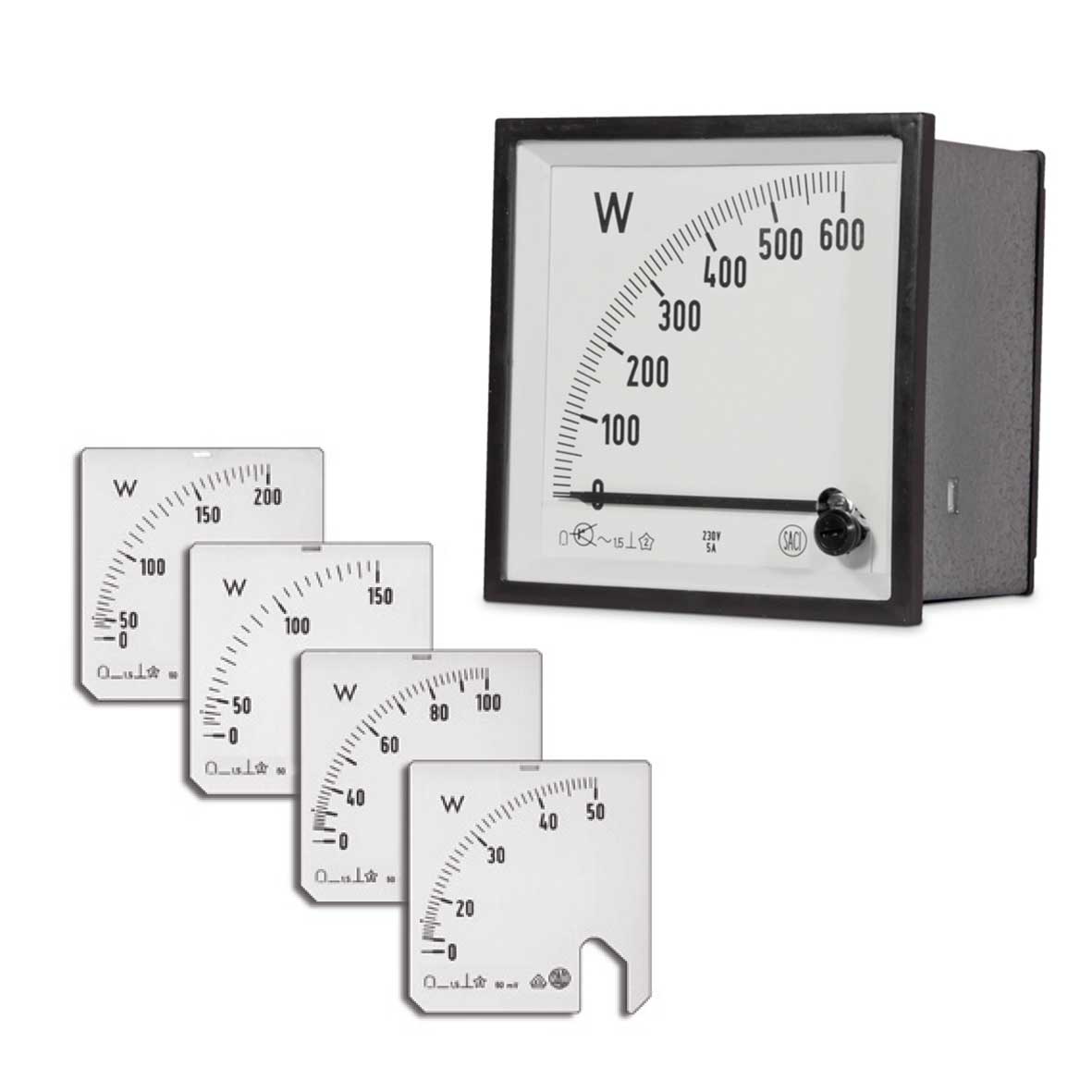
Electronic wattmeters
Measurement of active power, on three-phase alternating current lines
Measurement of active power, on three-phase alternating current lines
Technical details
- Description
- Technical characteristics
- Technical data
- Versions
What are wattmeters?
Wattmeters are electrical measuring devices that measure the power of an electrical circuit.
What are wattmeters used for?
Mainly, wattmeters allow professionals to detect which equipment is consuming the most electrical power in order to optimising consumption and reducing costs. In addition, they are also useful when it comes to detecting electrical problems and even prevent major errors.
On the other hand, they are also used in the system dimensioning to ensure an adequate supply and to prevent deficiencies or overloads from occurring. They are even used to check whether the complies with the regulations in force in many industries, where power consumption standards exist.
Lastly, they are also widely used in the field of quality control to ensure that the equipment is working properly, which is especially important in industrial processes. In conclusion, wattmeters are indispensable tools for any professional or company that wants to optimise and control electrical power consumption.
Main types of wattmeters
There are mainly two types of wattmeters on the market: the analogue wattmeter (ferrodynamic or electronic wattmeter with needle) and the digital wattmeter, both with their advantages and their peculiarities. At SACI we have both models, but the one we present in this case is an electronic wattmeter, within the range of analogue wattmeters.
Their main difference is that the analogue wattmeter uses electromechanical mechanisms to analyse the measurement, which is displayed with a needle on a graduated watt scale.
The main advantage of the analogue wattmeter over the digital wattmeter is that the electronic wattmeter has an simpler design and is often less expensive, It is also easier to use.
SACI analogue wattmeters, high accuracy for single-phase and three-phase installations
With our analogue wattmeter you can measure the power of your electrical systems with confidence. We have designed them to give you a reliable high precision in both single-phase and three-phase systems.
It is designed to be adaptable to a wide variety of needs and can be used in the industrial sector for process monitoring and control as well as in the energy sector for efficiency and consumption analysis. Other customers also use our wattmeter for use in commercial buildings or residential environments. It is also available in different models.
Characteristics of SACI electronic wattmeters
-
- High versatilityOur wattmeters are compatible with single-phase and three-phase systems, both balanced and unbalanced and 3- and 4-wire systems. They are also suitable for different voltages and currents.
- High precisionWith an accuracy of 1.5%, you are guaranteed a reliable measurement with this device.
- Easy installationThe device is accompanied by clear instructions and is available in different sizes and formats so that it can be adapted to any electrical panel.
- Robustnesscan withstand harsh environments.
We help you to choose the wattmeter you really need
If you do not know which wattmeter will best suit your needs, our team can help you and guide you through the selection process. Please contact us if you need to, either by email or telephone.
In addition, in the technical data sheet section you can find all the detailed specifications and characteristics of each model that can help you to know which one is the most suitable for you.
SINGLE-PHASE AC / THREE-PHASE BALANCED 3 OR 4 WIRE
DIN rail:
WC5VRE* / WC5VRIE* - 45×52,5mm - 0,55kg
Panel - 90º scale
WC5VE*/ WC5VIE* - 48x48mm - 0,55kg
WC4VE*/ WC4VIE* - 72x72mm - 0,55kg
WC3VE/ WC3VIE - 96x96mm - 0,84kg
WC2VE/ WC2VIE - 144x144mm - 0,84kg
Panel - 240º scale
WC5CE*/ WC5CIE* - 48x48mm - 0,55kg
WC4CE*/ WC4CIE*- 72x72mm - 0,55kg
WC3CE/ WC3CIE - 96x96mm - 0,84kg
WC2CE/ WC2CIE - 144x144mm - 0,84kg
THREE-PHASE UNBALANCED 3-WIRE/ THREE-PHASE UNBALANCED 4-WIRE
DIN rail:
WC5VRIIE*/ WC5VR3E* - 45×52,5mm - 1kg
Panel - 90º scale
WC5VIIE*/ WC5V3E* - 48x48mm - 1kg
WC4VIIE*/ WC4V3E* - 72x72mm - 1kg
WC3VIIE/ WC3V3E - 96x96mm - 1,55kg
WC2VIIE/ WC2V3E - 144x144mm - 1,55kg
Panel - 240º scale
WC5CIIE*/ WC5C3E* - 48x48mm - 1kg
WC4CIIE*/ WC4C3E*- 72x72mm - 1kg
WC3CIIE/ WC3C3E - 96x96mm - 1,55kg
WC2CIIE/ WC2C3E - 144x144mm - 1,55kg
*With additional module: Model MBW...
-Frequency: 50 or 60 Hz
-Voltage margin: ±15 % Vn
-Voltage (Vn): 100, 110, 230, 400, 440 V
-Current Range: 20-120%
-Current Input (In): 5A, 1 A
-Accuracy: 1,5 %
-Own consumption: 3..12 mA (Voltage circuits)
Self-consumption: 0.5 VA - 5 A // 0.1 VA - 1 A (current circuits)
INTERCHANGEABLE SCALE (only 90° scale), for models: WC5V..., WC5VR..., WC4V... and WC3V....