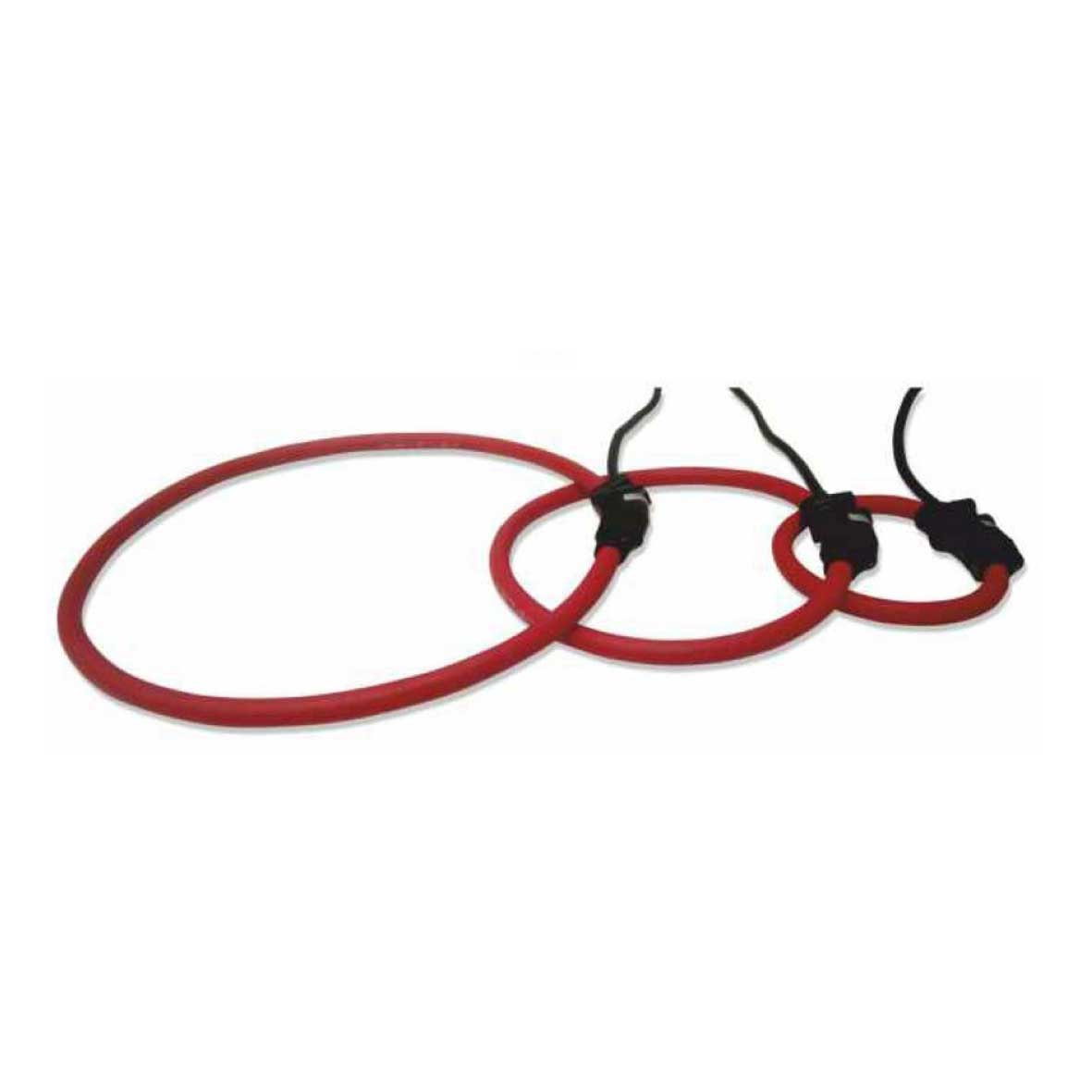
RC Rogowski coil
A Rogowski probe is a flexible current sensor based on the Rogowski coil principle and designed to measure alternating currents accurately and without direct current (DC) interference. The Rogowski RC Probe provides an advanced solution for installations requiring current monitoring in AC systems without risk of saturation or high power consumption.
A Rogowski probe is a flexible current sensor based on the Rogowski coil principle and designed to measure alternating currents accurately and without direct current (DC) interference. The Rogowski RC Probe provides an advanced solution for installations requiring current monitoring in AC systems without risk of saturation or high power consumption.
RC-70/ ø70mm
RC-120/ ø120mm
RC-200/ ø200mm
Technical details
- Description
- Technical characteristics
- Technical data
Thanks to its flexibility and rejection of DC components, this probe is perfect for complex installations where high accuracy and linearity are required, as well as being resistant to temperature variations. This type of sensor is very useful in confined or difficult to access spaces, thanks to its dimensions.
The Rogowski RC probe is compatible with any equipment whose input is 100mV.
Applications of the Rogowski RC probe in different industries
The Rogowski RC probe is used in different sectors requiring accurate AC current measurement, such as in:
- Industrial maintenance: allows monitoring of equipment consumption to improve energy efficiency.
- Renewable energies: very useful in solar and wind energy systems, where it helps to control AC power flows.
- Research and development: facilitates measurement in projects demanding high accuracy and low interference.
Model/ Cable
RC-70/ ø70mm
RC-120/ ø120mm
RC-200/ ø200mm
This probe has been designed for optimum accuracy and linearity in AC current measurement, offering the following specifications:
- Model: RC
- Typical output voltage: 100 μV/A
- Frequency range: 50 Hz - 60 Hz
- Accuracy: ±1% of the range
- Linearity: (10% to 100%) ± 0,2%
- Maximum temperature coefficient: ±0,05%
- Position Sensitivity (Union Cable): ±3%
- Rejection of external fields: ±2%